Printed in Korea
GH68-36430B
English (EU). 11/2012. Rev. 1.2
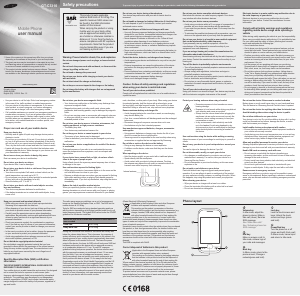
GT-C3310
Mobile Phone
user manual
• Some of the contents in this manual may differ from your phone
depending on the software of the phone or your service provider.
• Third party services may be terminated or interrupted at any time,
and Samsung makes no representation or warranty that any content
or service will remain available for any period of time.
• This product includes certain free/open source software. The exact
terms of the licenses, disclaimers, acknowledgements and notices
are available on the Samsung's website opensource.samsung.com.
Safety precautions
To prevent injury to yourself and others or damage to your device, read all of the following information before using your device.
Electronic devices in a motor vehicle may malfunction due to
the radio frequency of your device
Electronic devices in your car may malfunction due to radio
frequency of your device. Contact the manufacturer for more
information.
Comply with all safety warnings and regulations
regarding mobile device usage while operating a
vehicle
While driving, safely operating the vehicle is your first responsibility.
Never use your mobile device while driving, if it is prohibited by law.
For your safety and the safety of others, practice good common
sense and remember the following tips:
• Use a hands-free device.
• Get to know your device and its convenience features, such as
speed dial and redial. These features help you reduce the time
needed to place or receive calls on your mobile device.
• Position your device within easy reach. Be able to access your
wireless device without removing your eyes from the road. If you
receive an incoming call at an inconvenient time, let your voice
mail answer it for you.
• Let the person you are speaking with know you are driving.
Suspend calls in heavy traffic or hazardous weather conditions.
Rain, sleet, snow, ice, and heavy traffic can be hazardous.
• Do not take notes or look up phone numbers. Jotting down a
“to do” list or flipping through your address book takes attention
away from your primary responsibility of driving safely.
• Dial sensibly and assess the traffic. Place calls when you are not
moving or before pulling into traffic. Try to plan calls when your
car will be stationary. If you need to make a call, dial only a few
numbers, check the road and your mirrors, then continue.
• Do not engage in stressful or emotional conversations that may
be distracting. Make people you are talking with aware you are
driving and suspend conversations that have the potential to
divert your attention from the road.
www.sartick.com
This product meets applicable
national SAR limits of 2.0 W/kg. The
specific maximum SAR values can
be found in the SAR information
section of this manual.
When carrying the product or using
it while worn on your body, either
use an approved accessory such
as a holster or otherwise maintain a
distance of 1.5 cm from the body to
ensure compliance with RF exposure
requirements. Note that the product
may be transmitting even if you are
not making a phone call.
Warning: Prevent electric shock, fire, and explosion
Do not use damaged power cords or plugs, or loose electrical
sockets
Do not touch the power cord with wet hands, or disconnect the
charger by pulling on the cord
Do not bend or damage the power cord
Do not use your device while charging or touch your device
with wet hands
Do not short-circuit the charger or the battery
Do not drop or cause an impact to the charger or the battery
Do not charge the battery with chargers that are not approved
by the manufacturer
Do not use your device during a thunderstorm
Your device may malfunction and your risk of electric shock is
increased.
Do not handle a damaged or leaking Lithium Ion (Li-Ion) battery
For safe disposal of your Li-Ion batteries, contact your nearest
authorised service centre.
Handle and dispose of btteries and chargers with care
• Use only Samsung-approved batteries and chargers specifically
designed for your device. Incompatible batteries and chargers can
cause serious injuries or damage to your device.
• Never dispose of batteries or devices in a fire. Follow all local
regulations when disposing of used batteries or devices.
• Never place batteries or devices on or in heating devices, such
as microwave ovens, stoves, or radiators. Batteries may explode
when overheated.
• Never crush or puncture the battery. Avoid exposing the battery to
high external pressure, which can lead to an internal short circuit
and overheating.
Protect the device, batteries, and chargers from damage
• Avoid exposing your device and batteries to very cold or very hot
temperatures.
• Extreme temperatures can cause the deformation of the device
and reduce the charging capacity and life of your device and
batteries.
• Prevent batteries from contacting metal objects, as this can create
a connection between the + and – terminals of your batteries and
lead to temporary or permanent battery damage.
• Never use a damaged charger or battery.
Caution: Follow all safety warnings and regulations
when using your device in restricted areas
Turn off your device where prohibited
Comply with all regulations that restrict the use of a mobile device in
a particular area.
Do not use your device near other electronic devices
Most electronic devices use radio frequency signals. Your device
may interfere with other electronic devices.
Do not use your device near a pacemaker
• Avoid using your device within a 15 cm range of a pacemaker if
possible, as your device can interfere with the pacemaker.
• If you must use your device, keep at least 15 cm away from the
pacemaker.
• To minimise the possible interference with a pacemaker, use your
device on the opposite side of your body from the pacemaker.
Do not use your device in a hospital or near medical equipment
that can be interfered with by radio frequency
If you personally use any medical equipment, contact the
manufacturer of the equipment to ensure the safety of your
equipment from radio frequency.
If you are using a hearing aid, contact the manufacturer for
information about radio interference
Some hearing aids may be interfered with by the radio frequency of
your device. Contact the manufacturer to ensure the safety of your
hearing aid.
Turn off the device in potentially explosive environments
• Turn off your device in potentially explosive environments instead
of removing the battery.
• Always comply with regulations, instructions and signs in
potentially explosive environments.
• Do not use your device at refuelling points (service stations), near
fuels or chemicals, and at blasting areas.
• Do not store or carry flammable liquids, gases, or explosive
materials in the same compartment as the device, its parts, or
accessories.
Turn off your device when in an aircraft
Using your device in an aircraft is illegal. Your device may interfere
with the electronic navigation instruments of the aircraft.
• Use your device to call for help. Dial a local emergency number
in the case of fire, traffic accident, or medical emergencies.
• Use your device to help others in emergencies. If you see an
auto accident, a crime in progress, or a serious emergency
where lives are in danger, call a local emergency number.
• Call roadside assistance or a special, non-emergency assistance
number when necessary. If you see a broken-down vehicle
posing no serious hazard, a broken traffic signal, a minor traffic
accident where no one appears injured, or a vehicle you know
to be stolen, call roadside assistance or another special, non-
emergency number.
Proper care and use of your mobile device
Keep your device dry
• Humidity and all types of liquids may damage device parts or
electronic circuits.
• Do not turn on your device if it is wet. If your device is already
on, turn it off and remove the battery immediately (if the device
will not turn off or you cannot remove the battery, leave it as-is).
Then, dry the device with a towel and take it to a service centre.
• Liquids will change the colour of the label that indicates water
damage inside the device. Water damage to your device can void
your manufacturer’s warranty.
Do not use or store your device in dusty, dirty areas
Dust can cause your device to malfunction.
Do not store your device on slopes
If your device falls, it can be damaged.
Do not store your device in hot or cold areas. Use your device
at -20 °C to 50 °C
• Your device can explode if left inside a closed vehicle, as the
inside temperature can reach up to 80 °C.
• Do not expose your device to direct sunlight for extended periods
of time (such as on the dashboard of a car).
• Store the battery at 0 °C to 40 °C.
Do not store your device with such metal objects as coins,
keys and necklaces
• Your device may become deformed or malfunction.
• If the battery terminals are in contact with metal objects, it may
cause a fire.
Do not store your device near magnetic fields
• Your device may malfunction or the battery may discharge from
exposure to magnetic fields.
• Magnetic stripe cards, including credit cards, phone cards,
passbooks, and boarding passes, may be damaged by magnetic
fields.
• Do not use carrying cases or accessories with magnetic closures
or allow your device to come in contact with magnetic fields for
extended periods of time.
Do not store your device near or in heaters, microwaves, hot
cooking equipment, or high pressure containers
• The battery may leak.
• Your device may overheat and cause a fire.
Do not drop your device or cause impacts to your device
• The screen of your device may be damaged.
• If bent or deformed, your device may be damaged or parts may
malfunction.
Do not use your device or applications for a while if the device
is overheated
Prolonged exposure of your skin to an overheated device may
cause low temperature burn symptoms, such as red spots and
pigmentation.
If your device has a camera flash or light, do not use a flash
close to the eyes of people or pets
Using a flash close to the eyes may cause temporary loss of vision
or damage to the eyes.
Use caution when exposed to flashing lights
• While using your device, leave some lights on in the room and do
not hold the screen too close to your eyes.
• Seizures or blackouts can occur when you are exposed to flashing
lights while watching videos or playing Flash-based games for
extended periods. If you feel any discomfort, stop using the device
immediately.
Reduce the risk of repetitive motion injuries
When you repetitively perform actions, such as pressing keys,
drawing characters on a touch screen with your fingers, or playing
games, you may experience occasional discomfort in your hands,
neck, shoulders, or other parts of your body. When using your device
for extended periods, hold the device with a relaxed grip, press
the keys lightly, and take frequent breaks. If you continue to have
discomfort during or after such use, stop use and see a physician.
Ensure maximum battery and charger life
• Avoid charging batteries for more than a week, as overcharging
may shorten battery life.
• Over time, unused batteries will discharge and must be recharged
before use.
• Disconnect chargers from power sources when not in use.
• Use batteries only for their intended purposes.
Use manufacturer-approved batteries, chargers, accessories
and supplies
• Using generic batteries or chargers may shorten the life of your
device or cause the device to malfunction.
• Samsung cannot be responsible for the user’s safety when using
accessories or supplies that are not approved by Samsung.
Do not bite or suck on the device or the battery
• Doing so may damage the device or cause explosion.
• If children use the device, make sure that they use the device
properly.
When speaking on the device:
• Hold the device upright, as you would with a traditional phone.
• Speak directly into the mouthpiece.
• Avoid contact with your device’s internal antenna. Touching
the antenna may reduce the call quality or cause the device to
transmit more radio frequency than necessary.
Internal antenna
Do not use the device if the screen is cracked or broken
Broken glass or acrylic could cause injury to your hands and face.
Take the device to a Samsung Service Centre to have it repaired.
Do not use the device for anything other than its intended use
Avoid disturbing others when using the device in public
Do not allow children to use your device
Your device is not a toy. Do not allow children to play with it as they
could hurt themselves and others, damage the device, or make
calls that increase your charges.
Install mobile devices and equipment with caution
• Ensure that any mobile devices or related equipment installed in
your vehicle are securely mounted.
• Avoid placing your device and accessories near or in an air bag
deployment area. Improperly installed wireless equipment can
cause serious injury when air bags inflate rapidly.
Allow only qualified personnel to service your device
Allowing unqualified personnel to service your device may result in
damage to your device and will void your manufacturer’s warranty.
Handle SIM cards or memory cards with care
• Do not remove a card while the device is transferring or
accessing information, as this could result in loss of data and/or
damage to the card or device.
• Protect cards from strong shocks, static electricity, and electrical
noise from other devices.
• Do not touch gold-coloured contacts or terminals with your
fingers or metal objects. If dirty, wipe the card with a soft cloth.
Ensure access to emergency services
Emergency calls from your device may not be possible in some
areas or circumstances. Before travelling in remote or undeveloped
areas, plan an alternate method of contacting emergency services
personnel.
Protect your hearing and ears when using a headset
• Excessive exposure to loud sounds can cause
hearing damage.
• Exposure to loud sounds while driving may distract
your attention and cause an accident.
• Always turn the volume down before plugging the
earphones into an audio source and use only the
minimum volume setting necessary to hear your
conversation or music.
• In dry environments, static electricity can build
up in the headset. Avoid using headsets in dry
environments or touch a metal object to discharge
static electricity before connecting a headset to
the device.
Use caution when using the device while walking or moving
Always be aware of your surroundings to avoid injury to yourself or
others.
Do not carry your device in your back pockets or around your
waist
You can be injured or damage the device if you fall.
Do not disassemble, modify, or repair your device
• Any changes or modifications to your device can void your
manufacturer’s warranty. For service, take your device to a
Samsung Service Centre.
• Do not disassemble or puncture the battery, as this can cause
explosion or fire.
Do not paint or put stickers on your device
Paint and stickers can clog moving parts and prevent proper
operation. If you are allergic to paint or metal parts of the product,
you may experience itching, eczema, or swelling of the skin. When
this happens, stop using the product and consult your physician.
When cleaning your device:
• Wipe your device or charger with a towel or a rubber.
• Clean the terminals of the battery with a cotton ball or a towel.
• Do not use chemicals or detergents.
Keep your personal and important data safe
• While using your device, be sure to back up important data.
Samsung is not responsible for data loss.
• When disposing of your device, back up all data and then reset
your device to prevent misuse of your personal information.
• Carefully read the permissions screen when downloading
applications. Be particularly cautious with applications that have
access to many functions or to a significant amount of your
personal information.
• Check your accounts regularly for unauthorised or suspicious
use. If you find any sign of misuse of your personal information,
contact your service provider to delete or change your account
information.
• In the event your device is lost or stolen, change the passwords
on your accounts to protect your personal information.
• Avoid using applications from unknown sources and lock your
device with a pattern, password, or PIN.
Do not distribute copyright-protected material
Do not distribute copyright-protected material that you have
recorded to others without the permission of the content owners.
Doing this may violate copyright laws. The manufacturer is not
liable for any legal issues caused by the user’s illegal use of
copyrighted material.
Specific Absorption Rate (SAR) certification
information
THIS DEVICE MEETS INTERNATIONAL GUIDELINES FOR
EXPOSURE TO RADIO WAVES
Your mobile device is a radio transmitter and receiver. It is designed
not to exceed the limits for exposure to radio waves (radio
frequency electromagnetic fields) recommended by international
guidelines. The guidelines were developed by an independent
scientific organisation (ICNIRP) and include a substantial safety
margin designed to assure the safety of all persons, regardless of
age and health.
The radio wave exposure guidelines use a unit of measurement
known as the Specific Absorption Rate, or SAR. The SAR limit for
mobile devices is 2.0 W/kg.
Tests for SAR are conducted using standard operating positions
with the device transmitting at its highest certified power level in all
tested frequency bands. The highest SAR values under the ICNIRP
guidelines for this device model are:
Maximum SAR for this model and conditions under which it
was recorded
Head SAR 0.881 W/kg
Body-worn SAR 0.416 W/kg
During use, the actual SAR values for this device are usually well
below the values stated above. This is because, for purposes of
system efficiency and to minimize interference on the network, the
operating power of your mobile device is automatically decreased
when full power is not needed for the call. The lower the power
output of the device, the lower its SAR value.A body-worn SAR test
has been performed on this device with an approved accessory
or at a separation distance of 1.5 cm. To meet RF exposure
guidelines during body-worn operation, the device must be used
with the approved accessory or positioned at least 1.5 cm away
from the body. If you use an unapproved accessory, ensure
that the accessory does not contain any metal components and
that it positions the device at least 1.5 cm away from the body.
Organizations such as the World Health Organization and the US
Food and Drug Administration have suggested that if people are
concerned and want to reduce their exposure, they could use a
hands-free accessory to keep the wireless device away from the
body during use, or reduce the amount of time spent using the
device.For more information, visit www.samsung.com/sar and
search for your device with the model number.
(Waste Electrical & Electronic Equipment)
(Applicable in the European Union and other European
countries with separate collection systems)
This marking on the product, accessories or literature
indicates that the product and its electronic accessories (e.g.
charger, headset, USB cable) should not be disposed of
with other household waste at the end of their working life.
To prevent possible harm to the environment or human health from
uncontrolled waste disposal, please separate these items from other
types of waste and recycle them responsibly to promote the sustainable
reuse of material resources.
Household users should contact either the retailer where they purchased
this product, or their local government office, for details of where and
how they can take these items for environmentally safe recycling.
Business users should contact their supplier and check the terms and
conditions of the purchase contract. This product and its electronic
accessories should not be mixed with other commercial wastes for
disposal.
This EEE is compliant with RoHS.
Correct disposal of batteries in this product
(Applicable in the European Union and other European
countries with separate battery return systems)
This marking on the battery, manual or packaging indicates
that the batteries in this product should not be disposed of
with other household waste at the end of their working life.
Where marked, the chemical symbols Hg, Cd or Pb indicate that the
battery contains mercury, cadmium or lead above the reference levels
in EC Directive 2006/66. If batteries are not properly disposed of, these
substances can cause harm to human health or the environment.
To protect natural resources and to promote material reuse, please
separate batteries from other types of waste and recycle them through
your local, free battery return system.
www.samsung.com
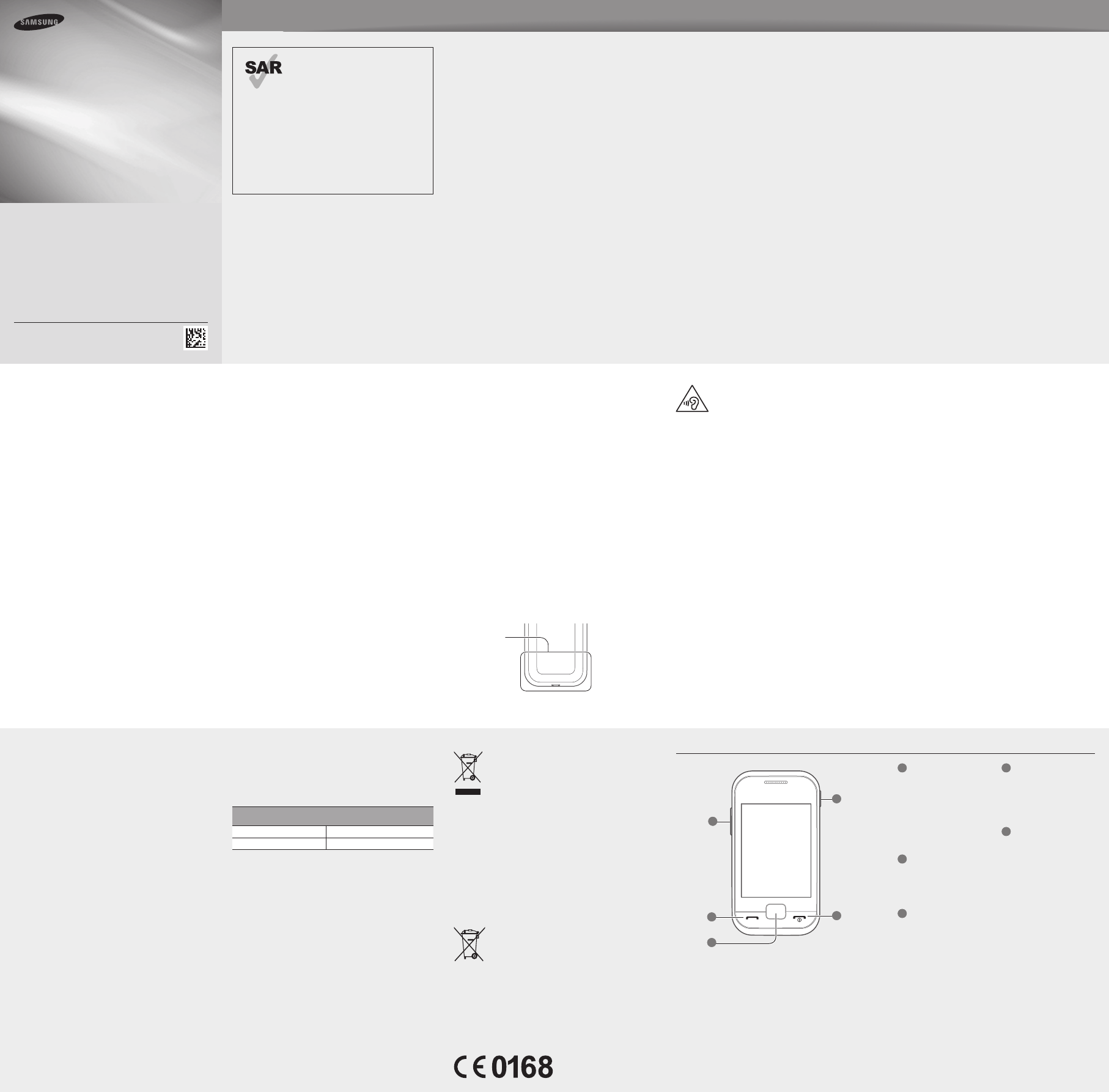
Phone layout
1
Volume key
In ldle mode, adjust the
phone’s volume; Make a
fake call (down); Send an
SOS message
See “Make fake calls”
See “Activate and send an
SOS message”
2
Dial key
Make or answer a call; In
Idle mode, retrieve logs of
your calls and messages
3
Back key
In Menu mode, return to the
previous level; Change a
network(press and hold)
4
Lock key
Lock the touch screen and
keys; Unlock the touch
screen and keys (press
and hold)
5
Power/End key
Turn the phone on or off
(press and hold); End a call;
In Menu mode, cancel input
and return to Idle mode
1
5
4
3
2


Delta i konversationen om denna produkt
Här kan du dela vad du tycker om Samsung GT-C3310 Mobiltelefon. Om du har en fråga, läs först noggrant igenom manualen. Att begära en manual kan göras genom att använda vårt kontaktformulär.