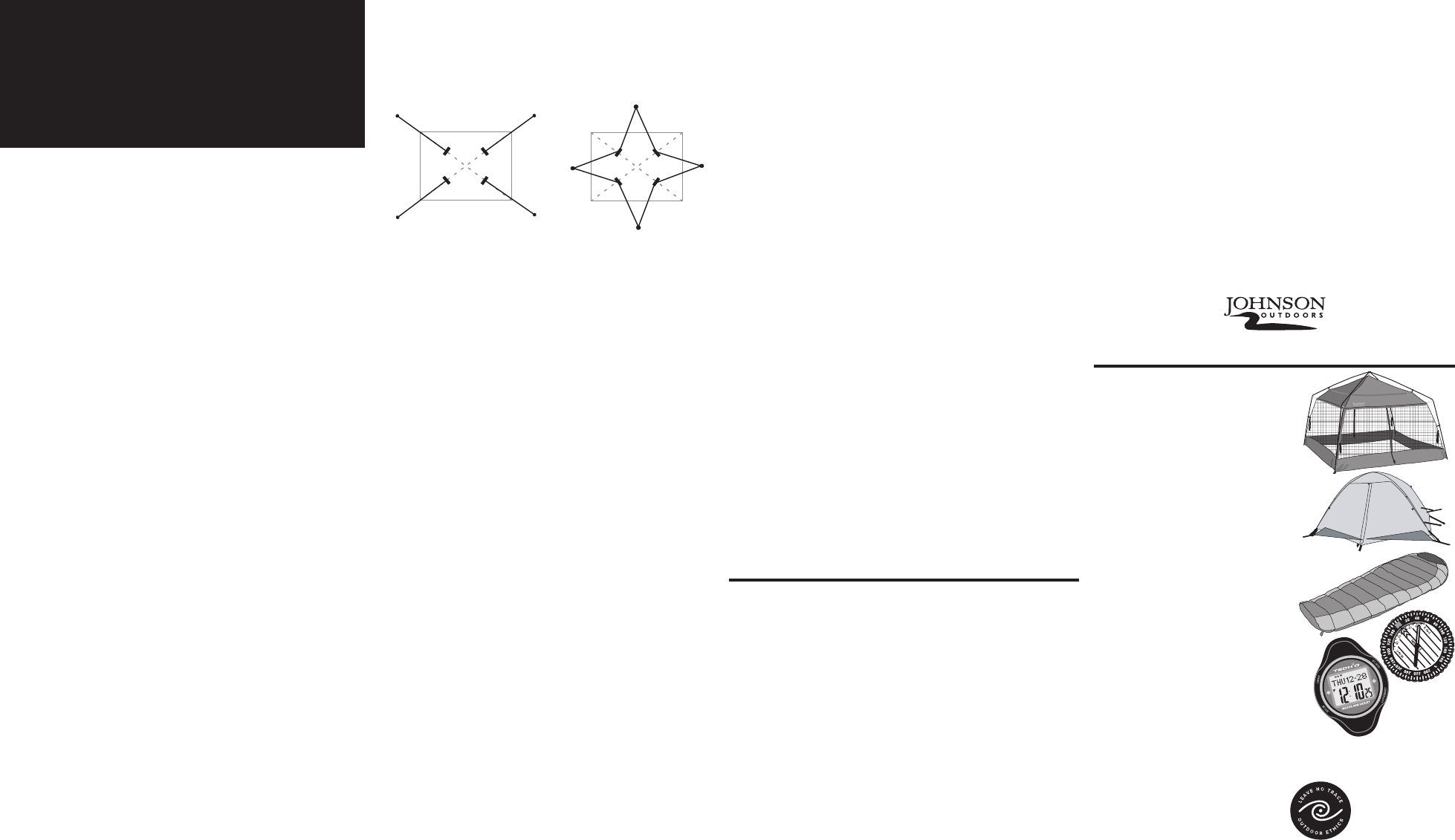
Good:
4 stakes /4 lines
Best:
4 stakes /8 lines
REV E. FEB 09
SEAM SEALING:
We recommend use of a sealer such as Kenyon Seam Sealer 3 or McNett Outdoor
SeamGrip
®
.
• Work in a fully ventilated area.
• Set the tent up or lay the tent out flat. Taut seams allow for even application and
penetration of the sealer.
• Decide which seams need to be sealed. For example, seams that will be exposed
to rain, runoff, or ground level water are a must for sealing, while seams on
uncoated nylon or mesh panels don’t need treatment. There is no need to seal
the seams in the roof or the factory taped seams. We recommend sealing both
floor and fly seams and reinforcements.
• Apply sealant to the inside and outside of all exposed seams. Several thin layers
will work better than one thick layer. Read and follow manufacture's instructions.
STAKING:
All tents need to be staked down to keep them from blowing away. Securing the
tent by placing heavy objects inside is just not adequate.
• Once the tent body is erected, stake it out before the fly is put on. This enables you
to square the tent up to ensure that the fly goes on properly and that the seams
align with the frame. Pull the base of the tent taut between each web stake out
loop or ring & pin. Make sure that all corners are square. It is important that you
don’t stake the tent out too tightly. You will know it’s too tight, if the door zippers
can not be easily operated. Drive stakes through the web loops, or with ring & pin,
drive the stake just outside the ring so that the “J” hook catches it. Tie a piece of
cord or web into a loop through the ring to be used as a large stake loop if
needed.
• With the tent properly staked, drape the fly over the frame, attach its tent
connection points and stake down any pull outs.
• Do not attempt to remove the stakes by pulling on the tent becket loop, as this
could cause the fabric to tear. The best way is to pry on the stake itself.
Staking in special conditions:
• Sand. Use long, broad stakes with plenty of surface area in loose soil.
• Hard, Rocky, or Frozen Soil. Steel stakes work best. Store steel stakes
separately. Their sharp edges can cut fabric and leave rust stains, which might
damage your tent.
• Snow. Use “dead man” anchors. Tie tent to buried objects (branches, tent bags, or
stuff sacks filled with snow; or tie tents to snow shoes, skis, or ski poles, which are
stuck in the snow.
GUY LINES:
Do not depend upon staking alone to keep your tent secure during high winds. Most
tent models have built-in loops or rings at optimal guy out locations. It’s important
to put in the extra time guying out your tent. Correctly done, it can save your tent
during exceptional weather.
• Make sure that the top fly is securely attached to the tent frame. Ties, hook and
loop, or dog-bones and elastic loops are sewn to the underside of the fly for this
purpose.
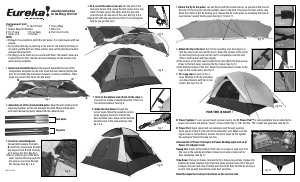
• Attach parachute cord to the loops/rings and stake them in the ground three or
four feet from the edge of the tent. If staked too close to the tent, wind can cause
an upward pull that could dislodge the stakes.
• If your tent does not have loops or rings for guy outs, attach guy lines 1/3 to
1/2 of the way up the framework on the main sidewalls. This enables the
guy line to support the lower section of the pole, while the upper pole can
flex and deflect wind gusts. It is best to run two cords at an angle from the
side of the guy out. This prevents all movement, except toward the anchor.
The guy lines will work together through opposition. See illustrations below:
CONDENSATION & VENTING:
Through perspiration and breathing, an adult gives off about a pint of water
overnight. If it cannot escape, the water vapor condenses to liquid. Most
often, water found in the tent is a result of this condensation rather than
from the tent leaking. Condensation often forms where the sleeping bag
touches the side of the tent, under the sleeping pad, or on coated surfaces
such as the door flaps. A tent’s double wall construction allows the vapor to
escape through the roof to the outside, keeping the inside of the tent dry.
Leave the windows partially open at night to provide cross ventilation and
further reduce condensation. Cross ventilation becomes more important in
very humid or extremely cold conditions when the permeable roof is less
effective. The features that enhance ventilation are windows, short-sheeted
flys (bottom venting), roof vents, and High/Low venting doors. These are
specific to each tent model.
Given the importance of proper ventilation, We use High/Low venting in most
of our tents. This allows cooler air in through the low vents and warmer,
moist air up and out through the high vents. High/Low venting is
accomplished within the inner tent via roof vents, doors and windows. It is
important to vent the vestibule. Unvented, it can inhibit airflow into the tent.
Our tent vestibules profit from the ability to “short sheet” by means of
zippers & toggles and staked vestibule pull outs create a bellowing effect.
Most of our tents are equipped with a High/Low venting door. This design
allows increased airflow into the tent from the bottom. Open the low
vent/window to admit cool air, allowing the warmer air out through the
high roof vents. When rain and wind prevent the low vent from being
opened, the high door vent can still be used. Fly overhangs or vestibules
protect it.
ULTRAVIOLET LIGHT:
Ultraviolet light damage to tent fabric is caused by excessive exposure to
sunlight. While our fabrics are UV resistant, any synthetic fabric is
susceptible to UV degradation. UV damage will cause nylon and polyester
to become brittle and tear easily. We recommend that you use the rain fly
even on clear days. It acts as a sunscreen to the tent. A rain fly is both easier
and less expensive to replace if damaged. UV damage can be minimized by
erecting tents on shaded sites with low exposure to direct sunlight.
GENERAL POLE CARE:
• Never let tent poles snap together as this can damage the pole end.
• Do not drop tent or pole bags on their ends and do not bounce a tent bag
on its end to get the tent out. These actions may cut the shock cord and
damage the pole ends.
• The aluminum frame may bend slightly and take a “set” through usage; this
normally does not affect the performance of the frame.
GENERAL TENT CARE:
• Sweep the tent floor daily to prevent damage from stones.
• Try not to wear shoes inside your tent.
• Use a ground cloth whenever possible.
• Do not keep food inside a tent. Hungry critters will chew through tent fabric in
search of food.
STORAGE:
• Make sure the tent is completely dry, then store loosely rolled, in a dry, cool
place. To prevent dust from collecting on the tent, cover it with a cloth. This
allows the nylon/polyester fabric to breathe.
• Ideally, the tent poles should be stored in their fully assembled state. This
reduces the tension on the shock cord, prolonging its life.
• The tent bag should be used only as a carry sack and not for storage.
COLOR TRANSFER:
• Do to the nature of tent fabrics, color can transfer from darker to lighter
fabrics when the two fabrics are in contact over time when wet, damp or
exposed to the combination of moisture and high heat. This does not effect
the tent's performance. To prevent / minimize color transfer, always make
sure your tent is completely dry prior to packing and storage.
CLEANING:
• Clean the tent by setting it up and wiping it down with a mild soap (liquid
hand soap) and lukewarm water solution. Rinse thoroughly and dry
completely. Never use detergent, washing machines or dryers because they
can damage the tent’s protective coating and seams. After cleaning, be sure
the tent is completely dry, especially the heavier, double-stitched areas such
as the seams, before storing or mold / mildew are likely to grow.
• Clean the tent poles with a cloth and lubricate them with silicone spray. This is
especially necessary after ocean side camping to remove salt spray so the
poles don’t corrode or stay gritty.
• Clean the zippers with a quick dip in water and then dry them off. This is
especially important if you’ve been camping in a location with sand/dirt. If
you don’t clean the zippers, the sliders will wear out and eventually the teeth
will become inoperable.
ALTERATIONS OR MODIFICATIONS:
DO NOT misuse, modify or alter this product in any way from its condition at
the time of sale. Alteration, modification or any use of this product contrary
to the accompanying written instructions shall void the warranty. Moreover,
any misuse, alteration or modification of the product shall absolve Johnson
Outdoors Gear LLC of any liability for property damages or injuries sustained
as a result of such misuse, modification or alteration.
LIMITED WARRANTY:
What Is Covered: Johnson Outdoors Gear LLC
warrants to the original
purchaser that its products are free from defects in material and workmanship,
for the life of the product, except as qualified below. The life of the product is
determined from the date of purchase until such time as the product is no longer
serviceable due to normal wear and tear.
What Is Not Covered:
Johnson Outdoors Gear LLC
shall not be responsible for the
natural breakdown of materials that occurs inevitably with extended use (e.g., Ultra
Violet (UV) light damage on tents, exhausted zippers), or defects caused by accident,
abuse, alteration, animal attack, storm damage, misuse or improper care.
THERE ARE NO OTHER EXPRESS WARRANTIES BEYOND THE TERMS OF THIS
LIMITED WARRANTY. IN NO EVENT SHALL JOHNSON OUTDOORS GEAR LLC BE
LIABLE FOR INCIDENTAL OR CONSEQUENTIAL DAMAGES.
Some states do not allow the exclusion or limitation of incidental or consequential
damages, so the above limitation or exclusion may not apply to you.
What Johnson Outdoors Gear LLC Will Do: If after inspection we find that a
product failed due to a manufacturing or material defect, we will repair or
replace the product, at our option, without charge.
How to Obtain Warranty Service: Return the product, freight prepaid, to the
Dealer from whom it was purchased; or, contact our Customer Satisfaction
Department for return authorization: toll free 1-800-572-8822. Collect
shipments or shipments without return authorization cannot be accepted. The
product registration card packaged with our product need not be returned for
the warranty to be effective and for you to receive warranty service.
Repairs: If your
Johnson Outdoors Gear LLC
product needs service or repair
due to normal wear and tear, animal attack, accident or some other reason
that is not covered under the warranty we will provide the necessary service
for a reasonable charge, plus shipping and handling. We require that products
accepted for any repair be properly cleaned according to our recommended
care instructions. Please send your product or component that requires repair
(e.g., tent fly), postage prepaid, along with a description of what needs
attention. For service and repairs, please contact our Customer Satisfaction
Department: toll free 1-800-572-8822
How State Law Relates To This Warranty: This warranty gives you specific
legal rights, and you may have other rights that vary from state to state.
Our experience building quality
outdoor equipment goes back over 100
years! Today, we manufacture sleeping
bags, screen houses, day-use
shelters and camping tents. We also
design and manufacture tents for the
United States Military and for the
rental industry.
See eurekatents.com
From baseplate and digital
compasses to electronic
instruments, our sister brands, Silva
and Tech4o, put outdoor technology at
your fingertips.
See tech4o.com and silvausa.com
Our brands are part of the Johnson
Outdoors family of products. Visit all
the brands at johnsonoutdoors.com
We support the "Leave No Trace"
Seven Principles:
1. PLAN AHEAD AND PREPARE
2. TRAVEL & CAMP ON DURABLE SURFACES
3. DISPOSE OF WASTE PROPERLY
4. LEAVE WHAT YOU FIND
5. MINIMIZE CAMPFIRE IMPACTS
6. RESPECT WILDLIFE
7 . BE COURTEOUS OF OTHER VISITORS
JOHNSON OUTDOORS GEAR LLC
WARNING:
KEEP ALL FLAME AND HEAT SOURCES AWAY FROM THIS TENT FABRIC.
• This tent meets the flammability requirements of CPAI-84. The fabric may
burn if left in continuous contact with any flame source. The application of
any foreign substance to the tent fabric may render the flame-resistant
properties ineffective.
• Do NOT operate any device which burns fuel inside your tent. Combustion
consumes oxygen and can produce dangerous levels of carbon monoxide,
which could lead to serious injury or death.


Delta i konversationen om denna produkt
Här kan du dela vad du tycker om Eureka Grand Manan 7 Tält. Om du har en fråga, läs först noggrant igenom manualen. Att begära en manual kan göras genom att använda vårt kontaktformulär.